Paid advice before a build is worth it when several approaches are plausible and picking the wrong one would be expensive to undo. It's usually wasted money when the job is small, clear and easy to reverse. If you can describe the task in two sentences and the worst outcome is a modest rework, collect quotes and get on with it.
The interesting cases sit in between, so it helps to compare the three routes most people have.
Quotes, advice or a small proof
Collecting quotes is cheap and fast. It shows you what studios charge for the thing you described. What it hides is whether you described the right thing. A quote answers "what would it cost to build this?", not "should we build this, or something else?" Every studio is also pricing from the same incomplete brief, so wide gaps between quotes often mean the brief left room for different assumptions. Quotes tell you the spread; they rarely tell you why.
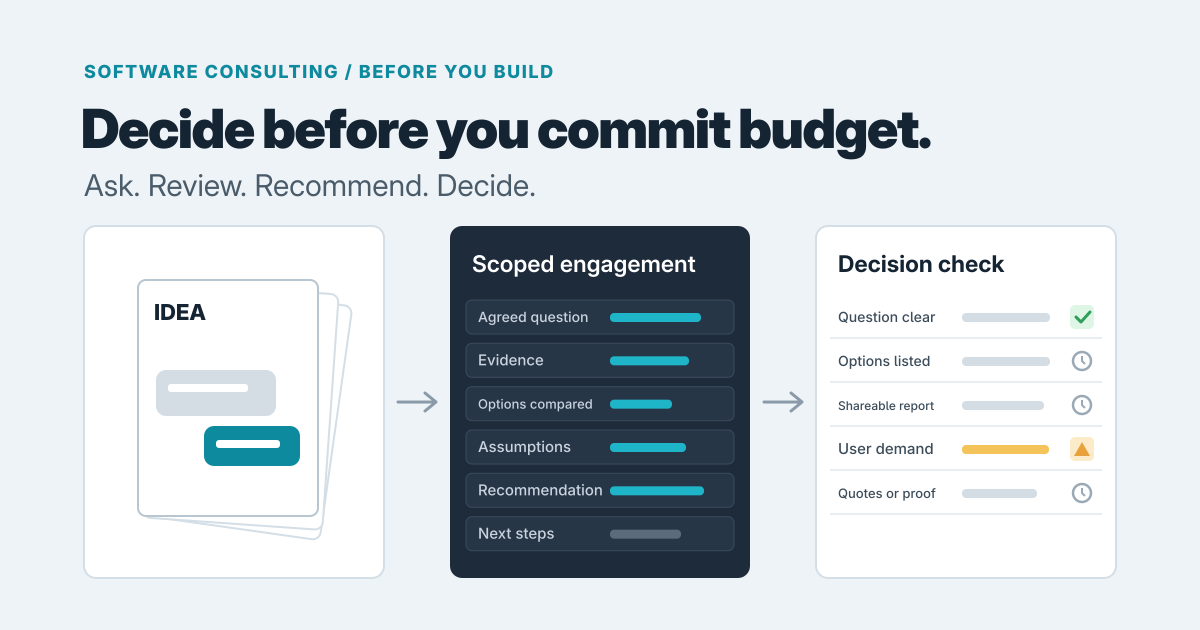
A paid consulting engagement buys a decision. You agree on a question, the consultant reviews the evidence, and you get a recommendation you can act on. It reveals tradeoffs, hidden dependencies and sometimes a cheaper path. What it hides is anything that only real use can show.
A small proof is a thin working version of the riskiest part. It's the best way to learn whether people will actually use something, because it puts the idea in front of them. It's a poor way to settle architecture, since a quick proof tends to harden into the real thing whether or not it should.
These aren't exclusive. Advice can decide what the proof should be, and a proof can feed the quotes.
Where advice earns its fee
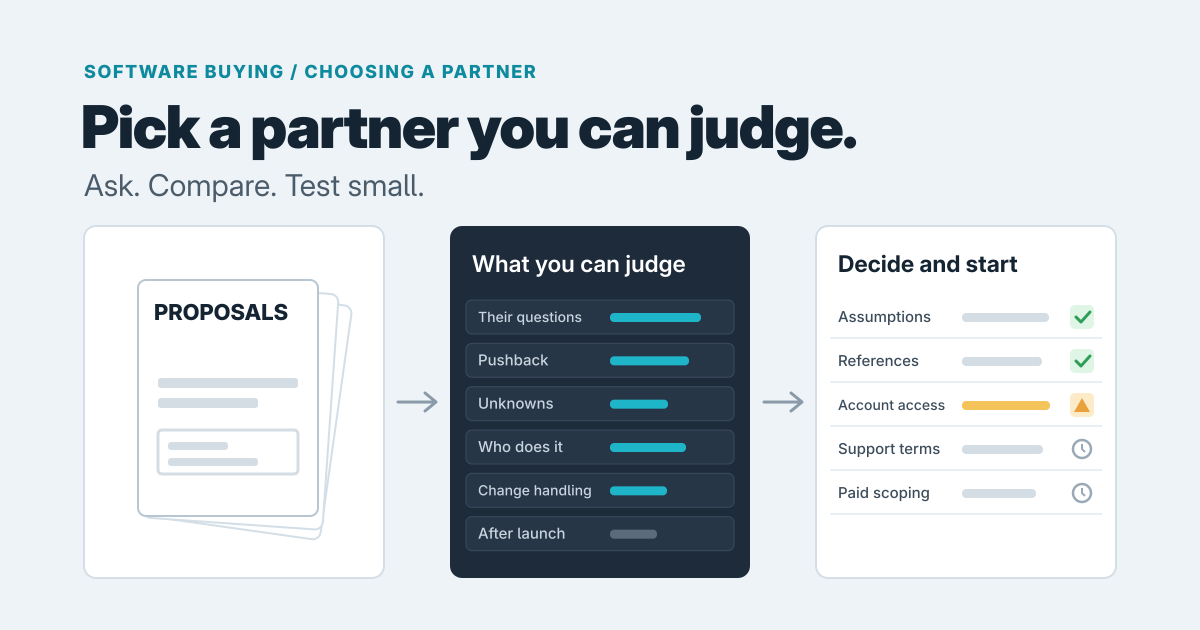
We would point to three situations where paying for advice first makes sense.
The tradeoffs are unclear. Maybe you could extend your current tool, buy a product with a thin integration layer, or build something custom. Each has a different cost curve. A neutral review of those options is worth more than three quotes for the most expensive one. Agency guides often describe discovery as a modest slice of a build budget; one puts it at 5 to 10 percent and another at 5 to 15 percent. Those are vendor figures without a stated method, so treat them only as a rough sense of proportion: a smaller spend before a larger one.
An AI idea has no defined task. "Use AI on our documents" isn't buildable yet. Advice can pin down the concrete task, whether the inputs are suitable, what a good answer looks like and how errors get caught. Our article on where AI fits in an internal workflow covers the boundaries, and a consultant can apply them to your actual process.
Nobody has mapped the process. If the work lives in people's heads and a few spreadsheets, a quote will bake in whoever's description reached the studio first. Mapping the real handoffs and exceptions first, as we describe in mapping the work before building custom software, usually changes the scope.
For example, say a founder wants an AI tool that reads supplier emails and updates orders. Quotes arrive at very different numbers. A short engagement could turn up anything: that the emails are too varied to automate, that the order system has no usable way in, or that a simpler tool already covers most of the need. The point is that the advice might reshape the project rather than price the original one, and nobody can promise in advance which way it goes.
Time is part of the case too. A widely cited study of very large IT projects, those starting above $15 million, reported that cost overruns grow the longer a project runs (McKinsey and Oxford study, summarized here). Yours is almost certainly smaller, so don't read it as a forecast. It's just one more reason to keep scope short and staged.
What a good engagement produces
Agree the deliverable before you start. A useful one contains:
- The question it answers, in the words you both signed off on.
- The evidence reviewed: your current process, systems, sample documents, interviews.
- A recommendation with its assumptions, so you can see what would change the answer.
- Tradeoffs between the real alternatives, including not building.
- Next steps sized so someone can start on Monday.
One vendor guide puts it bluntly: a discovery phase that ends with a vague list of features hasn't done its job. A good test is whether the document could be handed to a different team and they'd understand what to build and why.
The limits
Consulting can't remove uncertainty about demand. It can tell you a design is sound; it can't tell you customers will pay. For that, you need a small proof or real conversations.
A vague question also buys a vague answer. "Tell us about our software options" produces a survey. "Should we replace our quoting spreadsheet or connect it to our accounting system?" produces a decision.
It's also fair to say that studios offering discovery have a stake in it, and so do we. Be cautious with "free discovery" too, since studios have to recover that cost somewhere, often in the build estimate. Neither paid nor free is automatically honest. What matters is how the engagement is scoped.
How to judge a consultant
- Will they tell you not to build? Ask directly. If the answer is always a project, you're buying a sales step.
- Does the deliverable stand alone? You should be able to use it without the author.
- Can you take it to another studio? A report that only works with its writer's implementation team isn't advice, it's a lead-in. Ask to confirm the deliverable is yours to share.
- Do they review your actual evidence? Real documents and real workflows, not a generic template.
This also keeps the report off the shelf. Tie each recommendation to a decision someone owns and a date, so it turns into action rather than a PDF.
Writing the one-sentence question
Before talking to anyone, write this: "We need to decide whether to [option A] or [option B] for [specific process], given [main constraint], by [date]." For example: "We need to decide whether to extend our CRM or build a client portal for onboarding, given a small team and no developer, before next quarter's budget."
If you can't fill it in, that's useful information too: the first thing to buy is clarity about the question, and a short call usually settles that.
If you'd like to talk through whether your situation justifies paid advice, our software consulting service is built around that kind of scoped decision, and you can contact us with your one-sentence question. Sometimes the honest answer will be that quotes are enough.
Prepared with AI-assisted research and writing, with automated editorial checks before publication.