
A closer look at QueueMind.
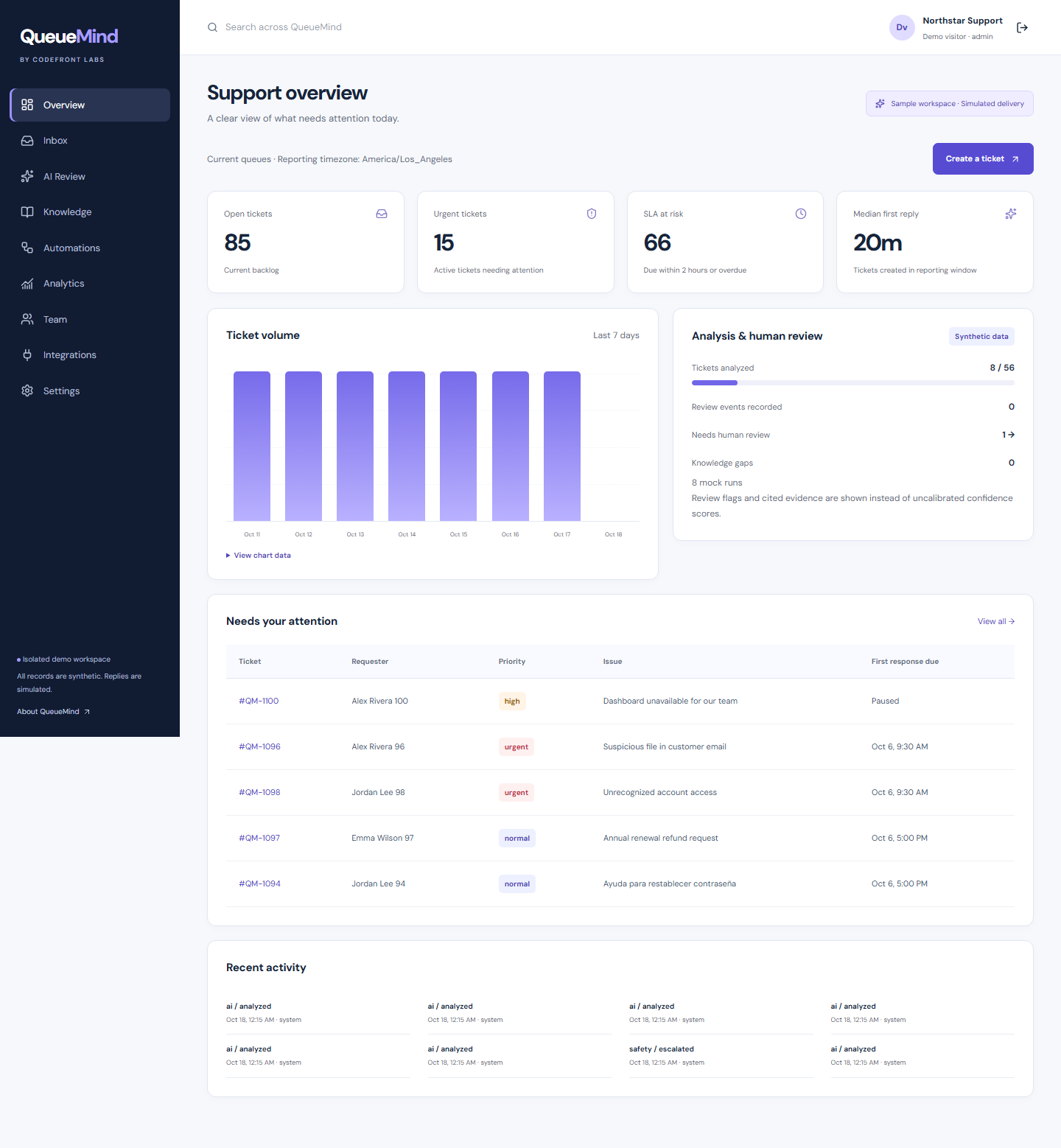
QueueMind brings ticket intake, knowledge, triage, and reviewed replies into one workspace. It is available through a direct implementation engagement with Codefront Labs; there is no self-service signup. The interactive demo creates an isolated Northstar Support workspace with synthetic tickets and knowledge. Visitors can create requests, inspect citations, correct suggestions, and confirm simulated replies. Scope, hosting, integrations, and support are agreed for each business implementation.
The challenge
A growing support queue is a coordination problem as much as a writing problem. Staff need to understand urgency, find current policy, choose the right team, and meet service targets without losing the context behind a reply. An unreviewed AI response can turn an uncertain answer into an unsupported promise.
The product experience
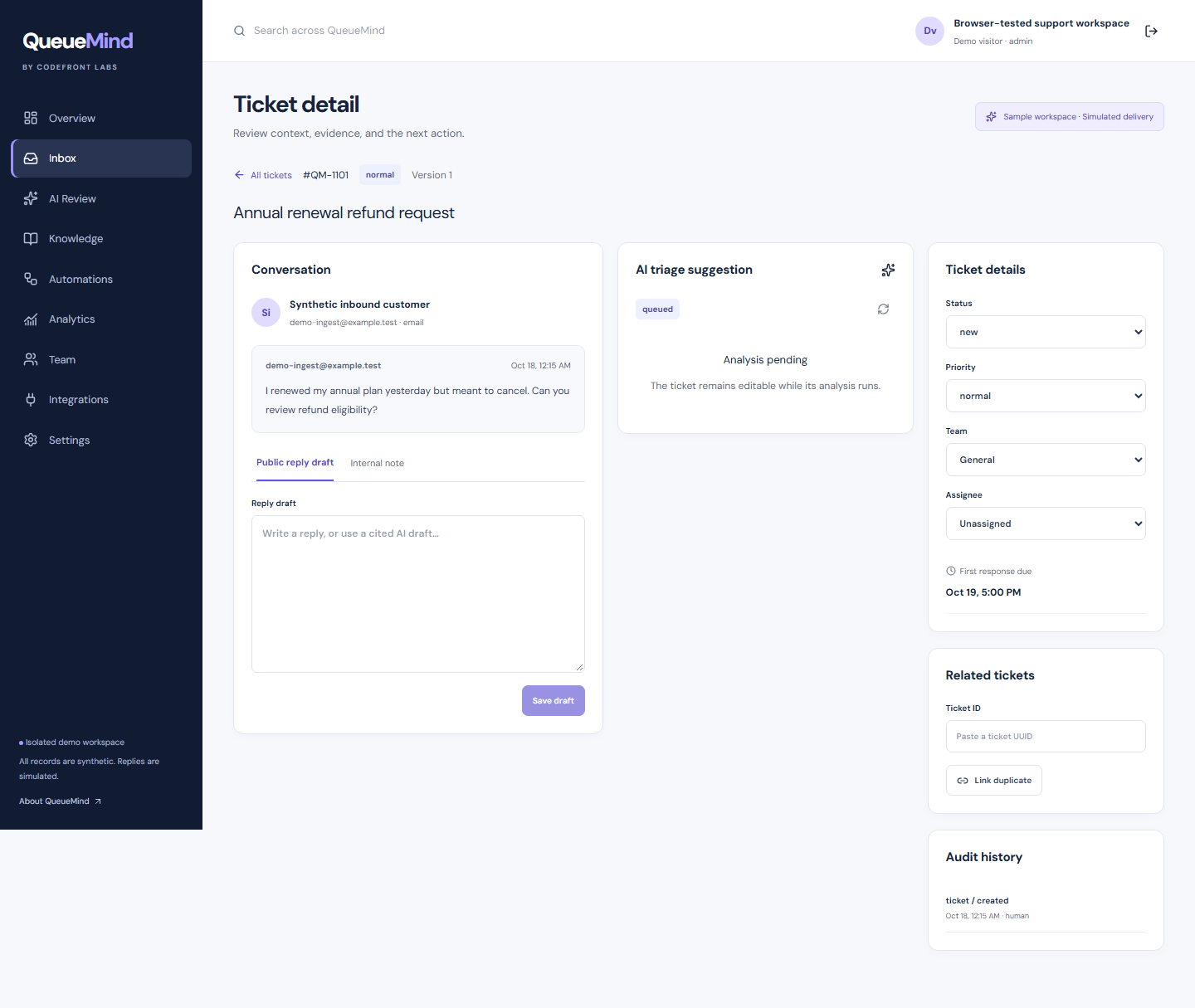
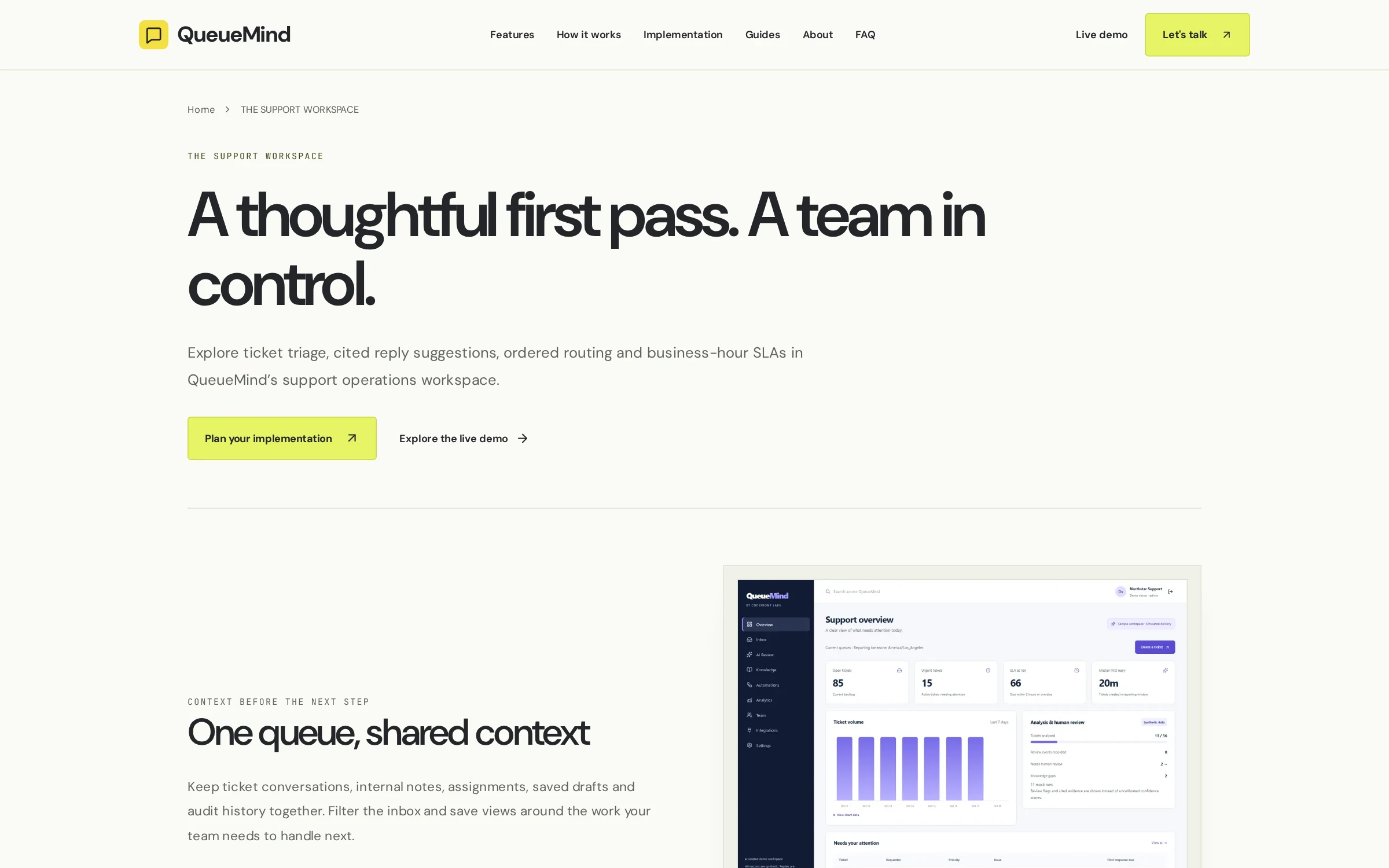
Incoming requests become persistent, searchable tickets with separate conversations, internal notes, and reply drafts. Background analysis proposes structured classifications and cited replies; ordered routing rules and deterministic SLA calendars control operational decisions. Reviewers can inspect exact source versions, correct or reject suggestions, link duplicate candidates without merging conversations, and explicitly confirm simulated delivery. Database-backed reporting and audit history make the resulting work inspectable.
- A working ticket-to-reviewed-reply workflow with persistent data, isolated demo access, and an inspectable simulated outbox.
- Tenant isolation, source-version preservation, security review, SLA calendars, confirmed outbound, signed inbound webhooks, and safe export behavior covered by automated tests.
- Ten functional workspace screens verified with browser workflows, accessibility checks, and mobile layouts. No customer support outcomes or business performance improvements are claimed.
Product & engineering
Next.js, TypeScript, and TanStack Query provide the workspace behind a same-origin API proxy. FastAPI verifies opaque server sessions, CSRF tokens, active membership, and role permissions. PostgreSQL stores tenant-owned tickets, versioned knowledge, immutable suggestions, feedback, and audit events. A transactional database outbox dispatches durable jobs through Redis/RQ. Retrieval filters current, active, tenant-visible sources before full-text ranking. ClamAV scans documents and private MinIO objects are encrypted at the application layer. Business calendars handle time zones, holidays, SLA pauses, and recorded breaches. The Docker backend and dedicated Cloudflare Tunnel run on Linux; the frontend runs on Vercel. One-use transfer grants avoid serverless file payload limits without making objects public.
The decisions that shape the work
Keep assistance separate from authority
Models propose classifications and drafts. Ordered rules, permissions, safety flags, and explicit human confirmation determine what can happen.
Retain the exact evidence
Store source-version excerpts with a suggestion so a later article revision does not silently change the basis of an earlier draft.
Make the demo safe to explore
Create an isolated synthetic workspace per visitor and record simulated delivery only, while showing the provider used for each analysis.
Working within the constraints
- The public demo uses synthetic data and a deterministic analysis provider. Its replies are simulated; no customer email leaves the workspace.
- A configurable OpenAI-compatible provider is implemented and a bounded synthetic OpenAI check has been verified. This does not establish production model accuracy.
- A suggestion cannot send a message. Security incidents require lead review, while roles, workspace boundaries, and explicit confirmation constrain actions.
- Live delivery, invitation email, and additional customer-system integrations require implementation-specific setup. They are not advertised as connected in the public demo.
Have a similar challenge?
For teams that need support automation adapted to their knowledge, service rules, review responsibilities, and existing systems.
Talk about your project