A legacy system can be difficult to change and still be essential to the business. Replacing it all at once may sound clean, but it forces the team to move every workflow, dependency, record, and user at the same time. That concentrates risk into one large release.
An incremental approach begins with a smaller question: which part of the work can be separated, understood, and verified without asking every user to switch at once?
Find a seam with a clear boundary
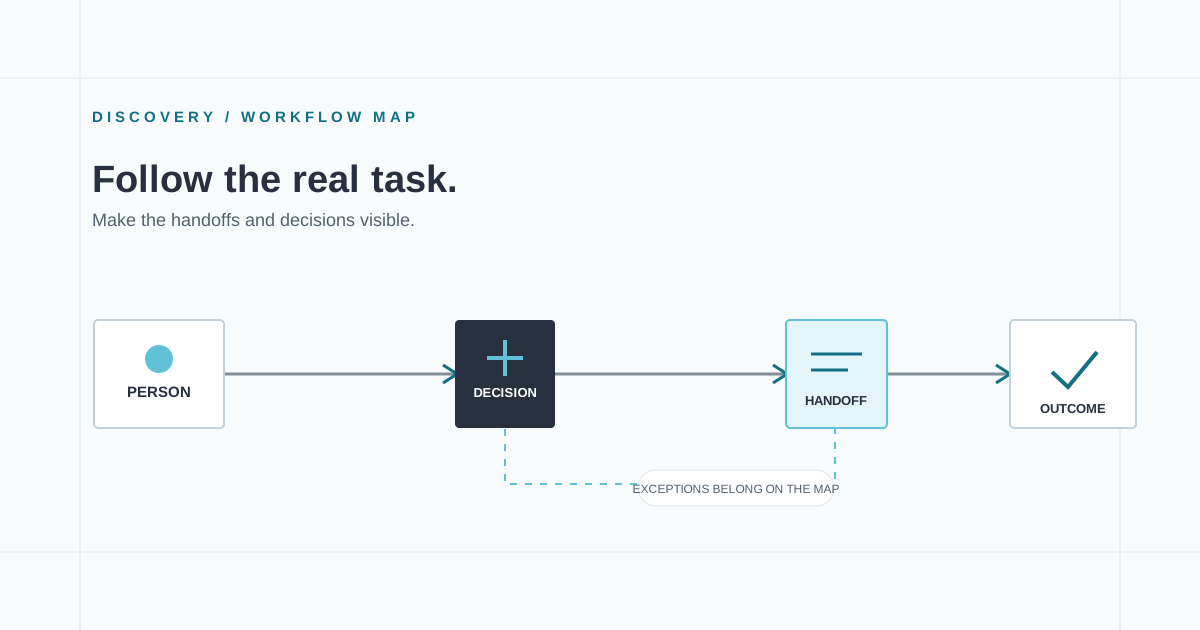
Map the current workflow and the systems that read or write its data. Look for a capability with a defined input and output, a limited number of consumers, and a way to compare the old and new behavior. A useful first slice is often a repeated task that is painful enough to matter but bounded enough to observe.
Do not choose a component only because its code looks old. Choose it because the business can describe what it does, who depends on it, and how to tell whether the replacement is correct. If those answers are missing, discovery and characterization tests may be the safest first work.
Keep the existing path available
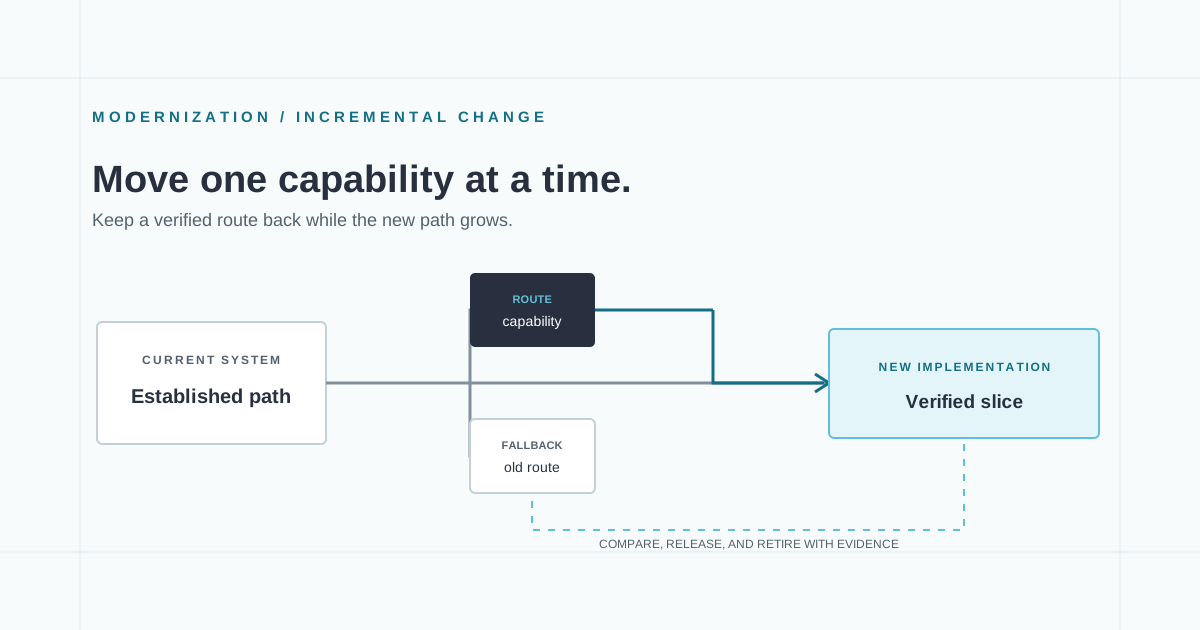
One modernization option is the strangler pattern: route a specific capability through a boundary, then move that capability to a new implementation while the rest of the system continues to serve users. AWS Prescriptive Guidance describes this as an incremental replacement pattern rather than a single cutover.
The pattern is not a fit for every system. It depends on a boundary where behavior can be intercepted and routed. If the code to replace is buried behind internal dependencies, a branch-by-abstraction approach or a simpler in-place refactor may fit better. If the system is small and well understood, a carefully planned replacement may be less complex than adding a permanent routing layer.
Protect data and behavior
Before moving the first workflow, write down the invariants that must remain true. Which record is authoritative? Can the old and new paths both write? How are duplicate events recognized? How will a partial migration be reconciled? Who can repair a mismatch?
Compare representative results from the current and replacement paths. Start with read-only or shadow comparisons where possible, then move a bounded set of users or operations. Define the condition for stopping, switching back, or expanding the rollout before the first change reaches production.
Keep observability focused on the transition: which path handled the request, whether the outcome matched expectations, and which errors need attention. Avoid logging private data simply to make a comparison easier.
Retire old behavior deliberately
Incremental replacement can leave a long-lived layer of adapters, duplicate data paths, and unclear ownership if no one tracks the end state. For each slice, record what was replaced, what still depends on the old path, and what evidence is needed before removing it. Put the remaining old-system behavior on a visible plan rather than assuming it will disappear later.
Plan the first slice together
A sensible modernization plan names the workflow, dependencies, data authority, verification method, release boundary, and rollback owner. It also says what will remain untouched until the first slice is proven.
The goal is not to make a legacy system modern in name. It is to reduce a real point of friction while keeping the work people depend on understandable and recoverable. If an aging workflow is making change harder, we can help map a safer modernization path.